
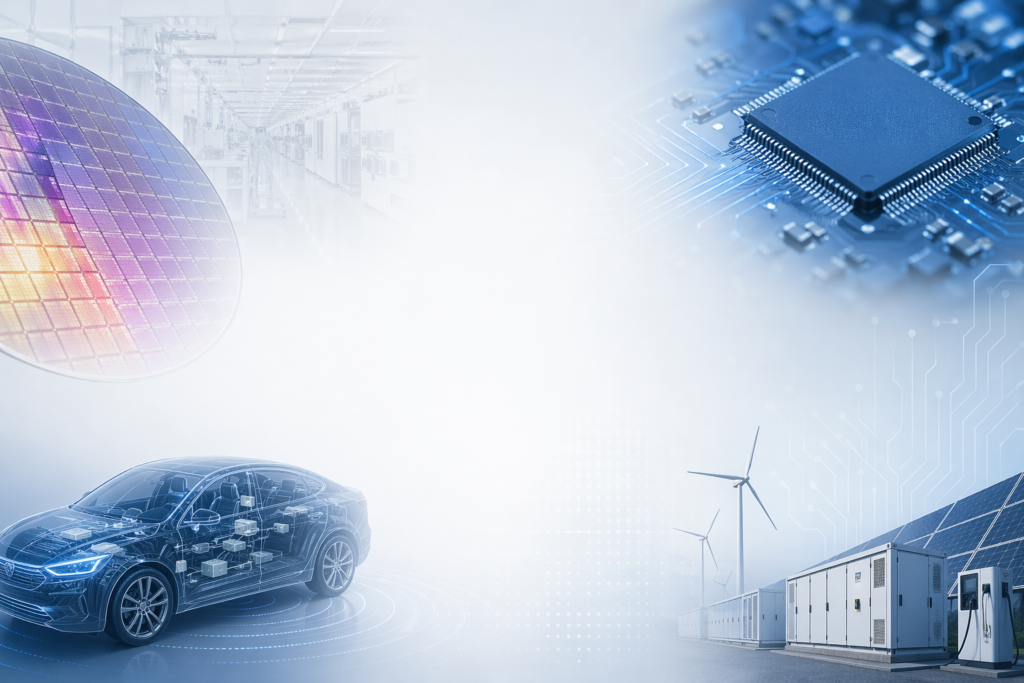
When people hear the word “chip,” they often think of cutting-edge nodes like 3nm or 7nm, EUV lithography, or AI computing power. But if you really want to understand semiconductors, focusing only on process nodes is a narrow entry point.
A more fundamental question comes first: how are chips actually classified?
Because in reality, a “chip” is not a single category—it’s a multidimensional system defined by signal type, function, manufacturing process, material, packaging, and application. Today’s semiconductor industry is not a single-track race led by advanced logic chips, but a complex ecosystem made up of logic ICs, memory, analog, power devices, sensors, RF components, and advanced packaging technologies.
According to World Semiconductor Trade Statistics (WSTS), the global semiconductor market reached $795.6 billion in 2025, growing 26.2% year-over-year. While logic and memory remain key growth drivers, the broader reality is clear: no single type of chip defines the industry.
To truly understand semiconductors, you need to view them across multiple dimensions.
1. Signal Domain: How Chips Interact with the Real World
At the most fundamental level, chips differ by the type of signals they process.
Analog ICs handle continuous real-world signals—temperature, sound, pressure, voltage, and current. They enable sensing, amplification, filtering, and power regulation. Companies like Texas Instruments emphasize that nearly all real-world data must pass through analog front-end processing before entering digital systems.
Digital ICs operate in the binary domain (0 and 1), enabling computation, storage, and data processing. CPUs, GPUs, MCUs, and FPGAs fall into this category.
Mixed-signal ICs bridge analog and digital worlds. Components like ADCs and DACs convert signals between domains, forming the backbone of systems such as industrial control, medical devices, and automotive electronics.
RF ICs (Radio Frequency) handle high-frequency wireless signals. From smartphones to automotive radar, RF front-end modules—widely developed by companies like Qorvo—integrate amplification, filtering, and switching for communication and sensing.
2. Functional Role: What the Chip Actually Does
From a system perspective, chips can be categorized by their core function:
- Compute (Processing): CPUs, GPUs, NPUs, DSPs
- Control: MCUs and embedded processors
- Memory: DRAM, NAND, SRAM, and HBM
- Connectivity: Interface ICs, Modems, RF chips
- Power Management: PMICs, power devices, drivers
- Sensing: MEMS and sensor ICs
For example, Infineon Technologies highlights the critical role of PMICs in automotive systems—from ADAS to powertrain control—while STMicroelectronics leads in MEMS sensors for IoT and mobility.
In reality, every modern electronic system is a collaboration of these functional blocks, not a single chip.
3.Manufacturing Node: Advanced vs. Mature Is About Fit, Not Superiority
Process nodes (3nm, 5nm, 28nm, etc.) are often misunderstood as a simple hierarchy of “better vs. worse.”
Advanced nodes—enabled by technologies like EUV from ASML—are designed for high-performance, high-density applications such as AI processors and flagship mobile SoCs.
Mature nodes (28nm and above), however, remain essential for analog ICs, power management, MCUs, and automotive chips. These applications prioritize reliability, cost efficiency, and long lifecycle over transistor density.
TSMC continues to invest heavily in both advanced and mature nodes, reinforcing a key industry truth:
the best process is the one that fits the application.
4. Material Systems: Silicon Dominates, but SiC and GaN Are Reshaping Power Electronics
While silicon remains the foundation of most semiconductor devices, new materials are redefining performance boundaries.
- Silicon (Si): Mainstream for logic, memory, and analog ICs
- Silicon Carbide (SiC): Ideal for high-voltage, high-temperature applications (EVs, renewable energy)
- Gallium Nitride (GaN): Enables high-frequency, high-efficiency power conversion
Companies like Wolfspeed and Navitas Semiconductor are driving adoption in electric vehicles, fast charging, and industrial power systems.
These materials are not replacements—but specialized solutions for specific performance demands.
5. Packaging & Integration: From Single Die to System-Level Innovation
Packaging is no longer just about protection—it’s now a performance multiplier.
Traditional packaging focuses on interconnection and thermal management. But advanced packaging technologies are transforming system architecture:
- 2.5D / 3D stacking
- Chiplet-based architectures
- High-bandwidth memory (HBM) integration
Technologies like 3DFabric and Foveros enable heterogeneous integration, combining multiple dies into a single high-performance system.
In AI and high-performance computing, packaging is now as critical as the silicon itself.
6. End Applications: Different Industries, Different Chip Logic
Ultimately, chips are defined by where they are used:
- Consumer Electronics: High integration, low power (smartphones, wearables)
- AI & Data Centers: Compute + memory bandwidth + advanced packaging
- Automotive: Reliability, safety, real-time performance
- Industrial & IoT: Longevity, stability, efficiency
- Energy Systems: Power conversion and efficiency (SiC/GaN driven)
Each application domain has its own optimization priorities—there is no “one-size-fits-all” chip strategy.
Conclusion: Understanding Semiconductors Means Thinking in Multiple Dimensions
The semiconductor industry is built on specialization and collaboration.
Some chips sense the world.
Some compute it.
Some connect it.
Some power it.
Some integrate everything into a working system.
So the next time you hear the word “chip,” don’t just ask whether it’s 3nm or AI-related.
Ask instead:
- What type of signal does it process?
- What function does it serve?
- What process and material is it built on?
- How is it packaged and integrated?
- Where is it ultimately applied?
Only by answering these questions together can you truly understand the semiconductor landscape.
KOT ELECTRONIC
Delivering reliable power semiconductors, passive components, and system-critical electronics for EV, industrial, and next-generation applications.