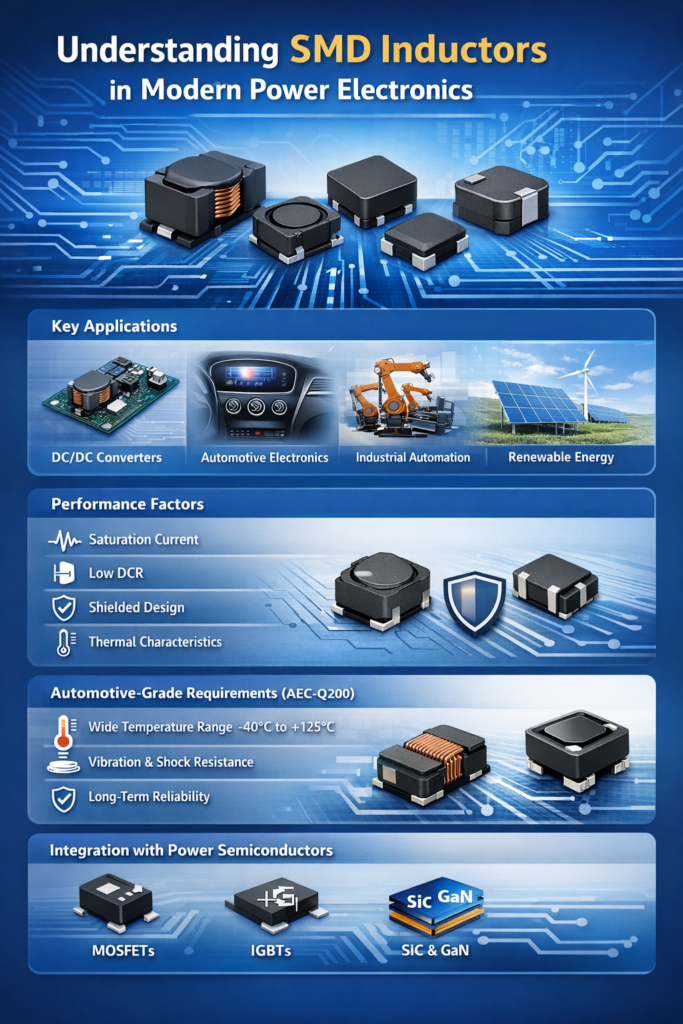
Surface-mount device (SMD) inductors play a fundamental role in today’s electronic systems, particularly in applications requiring efficient power conversion, noise suppression, and stable current control. As power electronics continue to evolve toward higher frequency and higher density designs, the selection of appropriate inductors becomes increasingly important.
Key Applications of SMD Inductors
SMD inductors are widely used across multiple industries, including:
-
DC/DC converters and power management circuits
-
Automotive electronics such as onboard power systems and infotainment
-
Industrial automation and motor control
-
Renewable energy systems and energy storage applications
In these environments, inductors contribute to energy storage, filtering, and electromagnetic interference (EMI) suppression, helping maintain system stability and efficiency.
Performance Considerations
When selecting an SMD inductor, several electrical and thermal parameters should be carefully evaluated:
-
Saturation current: Determines the maximum current the inductor can handle before inductance drops significantly
-
DC resistance (DCR): Impacts conduction losses and overall efficiency
-
Shielding structure: Affects EMI performance and suitability for compact layouts
-
Thermal characteristics: Influences long-term reliability under load
Designers often balance these parameters based on switching frequency, load conditions, and thermal constraints within the system.
Automotive and High-Reliability Requirements
In automotive and other harsh environments, inductors must meet higher reliability standards. Components qualified under Automotive Electronics Council AEC-Q200 guidelines are designed to withstand:
-
Wide temperature ranges (typically -40°C to +125°C or higher)
-
Mechanical vibration and shock
-
Long-term operational stress
Such requirements are critical for applications including power distribution modules, LED drivers, and onboard DC/DC converters.
Integration with Power Semiconductor Devices
SMD inductors are closely linked with power semiconductor devices such as MOSFETs, IGBTs, and wide bandgap components. In high-frequency switching systems, the interaction between inductors and switching devices directly affects:
-
Conversion efficiency
-
Thermal performance
-
Electromagnetic compatibility
Careful component selection and layout design are therefore essential to achieve optimal system performance.
Conclusion
As electronic systems continue to demand higher efficiency and compact form factors, SMD inductors remain a key element in power circuit design. A thorough understanding of their characteristics and application requirements can help engineers improve both performance and reliability in a wide range of use cases.
For reference, a range of SMD inductor options can be found on the KOT ELECTRONIC product page:
https://kotelectronic.com/product-category/smd-inductor/