
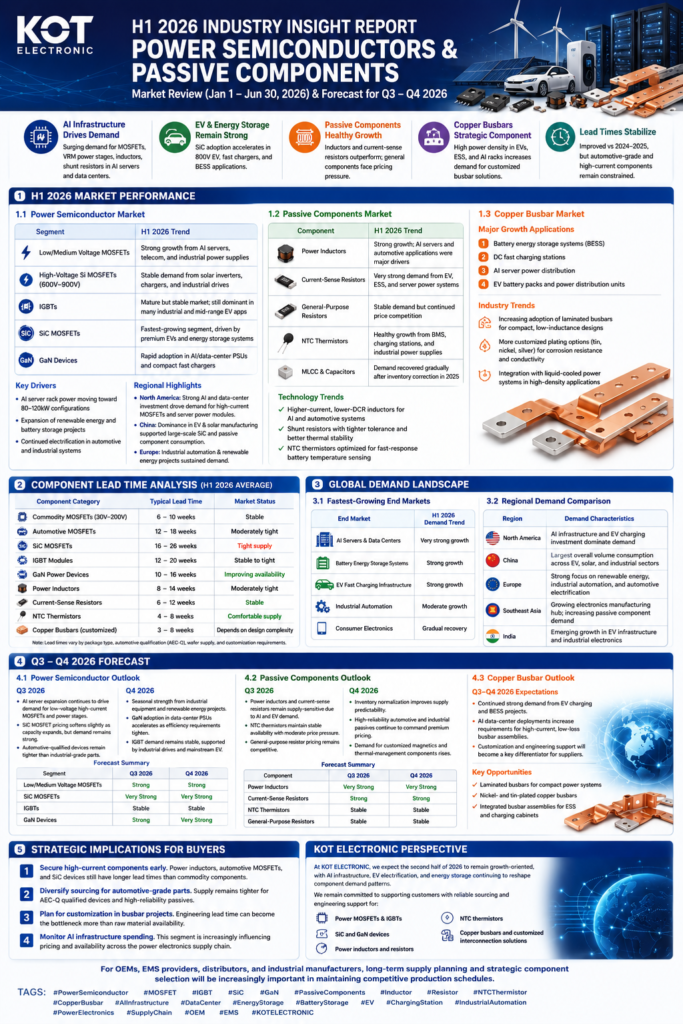
Power Semiconductors & Passive Components Market Review
Period: January 1 – June 30, 2026
Q3–Q4 2026 Forecast Included
Executive Summary
AI infrastructure became the strongest growth engine.
Demand surged for high-efficiency MOSFETs, VRM power stages, current-sense resistors, power inductors, and copper busbars used in AI servers and data centers.
EV and energy storage markets remained structurally strong.
SiC MOSFET adoption accelerated in 800V EV platforms, fast chargers, and battery energy storage systems (BESS).
Passive components saw mixed but generally healthy demand.
Inductors and current-sense resistors outperformed, while general-purpose commodity components faced pricing pressure due to inventory normalization.
Copper busbars emerged as a strategic component category.
Growing power density in EVs, ESS, and AI racks increased demand for customized high-current busbar solutions.
Lead times stabilized versus 2024–2025 peaks, but advanced automotive-grade and high-current components remain relatively constrained.
1. H1 2026 Market Performance
1.1 Power Semiconductor Market
Segment | H1 2026 Trend |
|---|---|
Low/Medium Voltage MOSFETs | Strong growth from AI servers, telecom, and industrial power supplies |
High-Voltage Si MOSFETs (600V–900V) | Stable demand from solar inverters, chargers, and industrial drives |
IGBTs | Mature but stable market; still dominant in many industrial and mid-range EV applications |
SiC MOSFETs | Fastest-growing segment, driven by premium EVs and energy storage systems |
GaN Devices | Rapid adoption in AI/data-center PSUs and compact fast chargers |
Key Drivers
AI server rack power moving toward 80–120kW configurations
Expansion of renewable energy and battery storage projects
Continued electrification in automotive and industrial systems
Regional Highlights
North America: Strong AI and data-center investment drove demand for high-current MOSFETs and server power modules.
China: Continued dominance in EV and solar manufacturing supported large-scale SiC and passive component consumption.
Europe: Industrial automation and renewable energy projects sustained demand for power semiconductors and busbars.
1.2 Passive Components Market
Component | H1 2026 Trend |
|---|---|
Power Inductors | Strong growth; AI servers and automotive applications were major drivers |
Current-Sense Resistors | Very strong demand from EV, ESS, and server power systems |
General-Purpose Resistors | Stable demand but continued price competition |
NTC Thermistors | Healthy growth from BMS, charging stations, and industrial power supplies |
MLCC & Capacitors | Demand recovered gradually after inventory correction in 2025 |
Technology Trends
Higher-current, lower-DCR inductors for AI and automotive systems
Shunt resistors with tighter tolerance and better thermal stability
NTC thermistors optimized for fast-response battery temperature sensing
1.3 Copper Busbar Market
Major Growth Applications
Battery energy storage systems (BESS)
DC fast charging stations
AI server power distribution
EV battery packs and power distribution units
Industry Trends
Increasing adoption of laminated busbars for compact, low-inductance designs
More customized plating options (tin, nickel, silver) for corrosion resistance and conductivity
Integration with liquid-cooled power systems in high-density applications
2. Component Lead Time Analysis (H1 2026 Average)
Component Category | Typical Lead Time | Market Status |
|---|---|---|
Commodity MOSFETs (30V–200V) | 6–10 weeks | Stable |
Automotive MOSFETs | 12–18 weeks | Moderately tight |
SiC MOSFETs | 16–26 weeks | Tight supply |
IGBT Modules | 12–20 weeks | Stable to tight |
GaN Power Devices | 10–16 weeks | Improving availability |
Power Inductors | 8–14 weeks | Moderately tight |
Current-Sense Resistors | 6–12 weeks | Stable |
NTC Thermistors | 4–8 weeks | Comfortable supply |
Copper Busbars (customized) | 3–8 weeks | Depends on design complexity |
Note: Lead times vary by package type, automotive qualification (AEC-Q), wafer supply, and customization requirements.
3. Global Demand Landscape
3.1 Fastest-Growing End Markets
End Market | H1 2026 Demand Trend |
|---|---|
AI Servers & Data Centers | Very strong growth |
Battery Energy Storage Systems | Strong growth |
EV Fast Charging Infrastructure | Strong growth |
Industrial Automation | Moderate growth |
Consumer Electronics | Gradual recovery |
3.2 Regional Demand Comparison
Region | Demand Characteristics |
|---|---|
North America | AI infrastructure and EV charging investment dominate demand |
China | Largest overall volume consumption across EV, solar, and industrial sectors |
Europe | Strong focus on renewable energy, industrial automation, and automotive electrification |
Southeast Asia | Growing electronics manufacturing hub; increasing passive component demand |
India | Emerging growth in EV infrastructure and industrial electronics |
4. Q3–Q4 2026 Forecast
4.1 Power Semiconductor Outlook
Q3 2026
AI server expansion will continue to drive demand for low-voltage high-current MOSFETs and power stages.
SiC MOSFET pricing is expected to soften slightly as capacity expands, but demand will remain strong.
Automotive-qualified devices will continue to experience tighter supply than industrial-grade parts.
Q4 2026
Seasonal strength from industrial equipment and renewable energy projects is expected.
GaN adoption in data-center power supplies should accelerate further as efficiency requirements tighten.
IGBT demand is likely to remain stable, supported by industrial drives and mainstream EV platforms.
Forecast Summary
Segment | Q3 2026 | Q4 2026 |
|---|---|---|
Low/Medium Voltage MOSFETs | Strong | Strong |
SiC MOSFETs | Very Strong | Very Strong |
IGBTs | Stable | Stable |
GaN Devices | Strong | Very Strong |
4.2 Passive Components Outlook
Q3 2026
Power inductors and current-sense resistors will remain supply-sensitive due to AI and EV demand.
NTC thermistors should maintain stable availability with moderate price pressure.
General-purpose resistor pricing is expected to remain competitive.
Q4 2026
Inventory normalization across the electronics industry should improve supply predictability.
High-reliability automotive and industrial passive components will continue to command premium pricing.
Demand for customized magnetics and thermal-management components is expected to rise.
Forecast Summary
Component | Q3 2026 | Q4 2026 |
|---|---|---|
Power Inductors | Very Strong | Very Strong |
Current-Sense Resistors | Strong | Strong |
NTC Thermistors | Stable | Stable |
General-Purpose Resistors | Stable | Stable |
4.3 Copper Busbar Outlook
Q3–Q4 2026 Expectations
Continued strong demand from EV charging and BESS projects.
AI data-center deployments will increase requirements for high-current, low-loss busbar assemblies.
Customization and engineering support will become a key differentiator for suppliers.
Key Opportunities
Laminated busbars for compact power systems
Nickel- and tin-plated copper busbars
Integrated busbar assemblies for ESS and charging cabinets
5. Strategic Implications for Buyers
Secure high-current components early.
Power inductors, automotive MOSFETs, and SiC devices still have longer lead times than commodity components.
Diversify sourcing for automotive-grade parts.
Supply remains tighter for AEC-Q qualified devices and high-reliability passives.
Plan for customization in busbar projects.
Engineering lead time can become the bottleneck more than raw material availability.
Monitor AI infrastructure spending.
This segment is increasingly influencing pricing and availability across the power electronics supply chain.
KOT ELECTRONIC Perspective
At KOT ELECTRONIC, we expect the second half of 2026 to remain growth-oriented, with AI infrastructure, EV electrification, and energy storage continuing to reshape component demand patterns.
We remain committed to supporting customers with reliable sourcing and engineering support for:
Power MOSFETs & IGBTs
SiC and GaN devices
Power inductors and resistors
NTC thermistors
Copper busbars and customized interconnection solutions
For OEMs, EMS providers, distributors, and industrial manufacturers, long-term supply planning and strategic component selection will be increasingly important in maintaining competitive production schedules.