
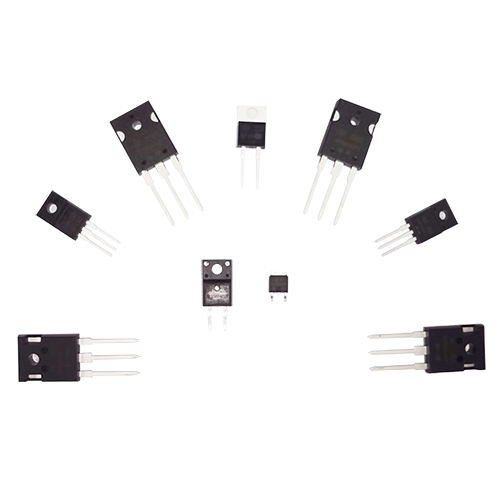
Q1 & Q2 2026 Market Review and Outlook
Power Semiconductors Driving the Next Wave of Electrification, Energy Storage, and AI Infrastructure
Published by KOT ELECTRONIC
Executive Summary
The first half of 2026 marked another significant phase in the evolution of the global power semiconductor industry. Unlike the supply-driven shortages experienced between 2021 and 2023, the market has entered a period characterized by structural demand growth, supported by accelerating investments in electric vehicles (EVs), renewable energy, battery energy storage systems (BESS), artificial intelligence (AI) data centers, and industrial electrification.
Although manufacturing capacity has continued to improve, the rapid expansion of high-growth applications has kept demand for advanced power devices—including Silicon Carbide (SiC) MOSFETs, IGBT modules, automotive-grade MOSFETs, and high-voltage power modules—at elevated levels. At the same time, passive components and copper interconnection solutions have become increasingly important in enabling higher efficiency, greater power density, and improved thermal management.
This report reviews the major developments of Q1 and Q2 2026, analyzes key market trends, and provides an outlook for the second half of the year.
1. Market Overview
Structural Demand Replaces Supply-Driven Growth
The global power semiconductor industry has transitioned into a new growth cycle. Instead of being driven by temporary shortages, demand is now underpinned by long-term investments in electrification and digital infrastructure.
Key growth drivers include:
- Expansion of electric vehicle production
- Growth in battery energy storage installations
- Renewable energy integration
- AI computing and hyperscale data centers
- Industrial automation and smart manufacturing
- Power infrastructure modernization
These sectors require increasingly sophisticated power conversion technologies capable of delivering higher efficiency, lower switching losses, and greater thermal performance.
2. Electric Vehicle Market Continues Leading Demand
Electric vehicles remain the largest single application for power semiconductors.
Transition Toward 800V Architectures
Throughout the first half of 2026, more vehicle manufacturers expanded deployment of 800V platforms, particularly in premium passenger vehicles and commercial EVs.
Compared with traditional 400V systems, 800V architectures provide:
- Faster charging capability
- Reduced cable weight
- Lower current losses
- Improved system efficiency
- Better thermal management
These advantages continue accelerating adoption of Silicon Carbide power devices.
Growing Adoption of Silicon Carbide (SiC)
SiC MOSFETs have become increasingly common in:
- Traction inverters
- DC fast chargers
- On-board chargers (OBC)
- DC/DC converters
Compared with conventional silicon devices, SiC offers:
- Lower switching losses
- Higher operating temperatures
- Higher switching frequencies
- Smaller passive components
- Improved overall system efficiency
Automotive OEMs continue expanding SiC adoption as battery capacities and charging power increase.
3. Energy Storage Systems Become a Major Growth Engine
Battery Energy Storage Systems (BESS) experienced another strong six months, supported by increasing renewable energy deployment and grid modernization projects.
Power semiconductor demand expanded across:
- Utility-scale storage
- Commercial storage
- Residential ESS
- Hybrid renewable power stations
Typical devices include:
- SiC MOSFETs
- IGBT modules
- High-voltage MOSFETs
- Power modules
- Gate drivers
- Power management ICs
As energy storage systems move toward higher voltages and larger capacities, power conversion efficiency has become a major design priority.
4. AI Infrastructure Reshapes Power Electronics
Perhaps the most significant development during Q1–Q2 2026 was the continued expansion of AI computing infrastructure.
Hyperscale cloud providers and AI developers significantly increased investment in:
- GPU clusters
- AI training servers
- High-performance computing
- Large-scale data centers
Unlike traditional enterprise servers, AI platforms require significantly higher electrical power.
Modern AI racks increasingly adopt:
- 48V power architectures
- Higher current densities
- Multi-phase voltage regulation
- High-efficiency DC-DC conversion
Consequently, demand has risen for:
- Low-RDS(on) MOSFETs
- GaN power devices
- High-frequency power modules
- Advanced power management ICs
AI infrastructure is rapidly becoming one of the fastest-growing markets for power semiconductor suppliers.
5. Wide-Bandgap Technologies Continue Expanding
Silicon Carbide (SiC) and Gallium Nitride (GaN) technologies continued gaining market share throughout the first half of the year.
Silicon Carbide
Primary applications include:
- EV traction systems
- Renewable energy inverters
- Energy storage converters
- Industrial motor drives
Gallium Nitride
Typical applications include:
- AI server power supplies
- Telecom infrastructure
- Consumer fast chargers
- Industrial power supplies
Wide-bandgap devices continue enabling:
- Higher switching frequencies
- Reduced cooling requirements
- Improved efficiency
- Smaller system footprints
6. Passive Components Become Strategic Technologies
As switching frequencies increase and power densities rise, passive components have become increasingly important.
Growing demand was observed for:
- High-current power inductors
- Automotive-grade MLCCs
- Precision resistors
- NTC thermistors
- Current sensing resistors
These components play critical roles in:
- Thermal protection
- EMI suppression
- Voltage filtering
- Current measurement
- System reliability
Rather than commodity products, passive components are increasingly viewed as integral elements of power system performance.
7. Copper Busbars Gain Strategic Importance
Copper busbars have evolved into critical components for modern high-current systems.
Applications continue expanding across:
- Electric vehicles
- Battery energy storage systems
- AI data centers
- Renewable energy inverters
- Industrial power cabinets
Design priorities now include:
- High-current capability
- Thermal optimization
- Compact integration
- Electromagnetic compatibility (EMC)
- Laminated busbar technology
Busbars are increasingly engineered as complete power distribution solutions rather than simple conductors.
8. Supply Chain Review
Compared with previous years, overall semiconductor availability improved during the first half of 2026.
However, several strategic product categories experienced renewed lead-time pressure.
Products showing extended lead times included:
- Automotive MOSFETs
- SiC MOSFETs
- Power inductors
- Precision resistors
- Automotive-grade MLCCs
This trend was primarily driven by simultaneous demand from EV, energy storage, AI infrastructure, and industrial automation sectors rather than by manufacturing shortages.
Companies increasingly adopted:
- Dual-source strategies
- Long-term purchasing agreements
- Safety inventory planning
- Cross-reference qualification
Supply chain resilience remains a key priority for OEMs and distributors.
9. Outlook for H2 2026
Looking ahead, the second half of 2026 is expected to remain positive for the global power semiconductor market.
Key themes likely to shape the industry include:
Continued EV Electrification
Further deployment of 800V architectures and increased SiC penetration.
Accelerated Energy Storage Growth
Grid-scale battery installations and renewable integration continue expanding globally.
AI Computing Infrastructure
AI servers and hyperscale data centers remain one of the strongest drivers for high-efficiency power electronics.
Regional Supply Chain Diversification
Manufacturers continue expanding production footprints across Asia, North America, and Europe to enhance resilience.
Growing Demand for High-Reliability Components
Automotive-grade and industrial-grade products are expected to maintain healthy demand and relatively firm pricing.
Conclusion
The first half of 2026 demonstrated that the power semiconductor industry has entered a new stage of sustainable, application-driven growth.
Electrification, renewable energy, and artificial intelligence are reshaping the global demand landscape, while advances in Silicon Carbide, Gallium Nitride, passive components, and copper busbar technologies are enabling higher efficiency and greater system integration.
For manufacturers, distributors, and OEMs, the focus is shifting from simply securing supply toward building resilient sourcing strategies, optimizing design efficiency, and preparing for the next generation of high-power electronic systems.
About KOT ELECTRONIC
KOT ELECTRONIC is a global supplier of power semiconductors, passive components, and copper busbar solutions, supporting customers across electric vehicles, renewable energy, energy storage, industrial automation, and AI infrastructure.
Our product portfolio includes:
- Power MOSFETs
- IGBT Modules
- Silicon Carbide (SiC) Devices
- Gallium Nitride (GaN) Solutions
- Power Inductors
- Resistors
- NTC Thermistors
- MLCC Capacitors
- Custom Copper Busbars
By combining global sourcing capabilities with technical expertise, KOT ELECTRONIC helps customers build resilient supply chains and deliver reliable, high-performance power electronics solutions.