

When buying a new smartphone, we power it on to check functionality.
When purchasing home appliances, we run a trial operation before use.
Power modules—the “heart” of power electronic systems—deserve even stricter validation.
From small household controllers to electric vehicles and large-scale power grid equipment, stable and reliable power module output is mission-critical. That is why, before leaving the factory, power modules must undergo a special endurance test: Reactive Power Aging Screening.
This process is not an unnecessary cost increase, but a key step to ensure long-term reliability. In this article, we explain—using plain language, core formulas, and real-world examples—why reactive power aging is an essential “rite of passage” for power modules.

Figure 1. Application Areas of Power Modules
1. What Is “Reactive Power Aging” in Power Modules?
First, a clarification:
“Reactive” does not mean “ineffective.”
In power engineering, reactive power refers to electrical energy that does not perform external mechanical work due to a phase difference (φ) between voltage and current. Instead, it creates internal electrical and thermal stress within the module.
Reactive power aging operates power modules under:
Rated voltage (U)
A controlled magnitude of reactive current (I)
Minimal active power output
The module runs continuously for dozens of hours under electrical and thermal stress conditions close to real operation, but without significant external energy consumption.
In simple terms:
Reactive power aging means “no external work, but intensive internal training.”
It simulates real working stress, minimizes energy waste, and—most importantly—forces latent manufacturing defects to surface early.
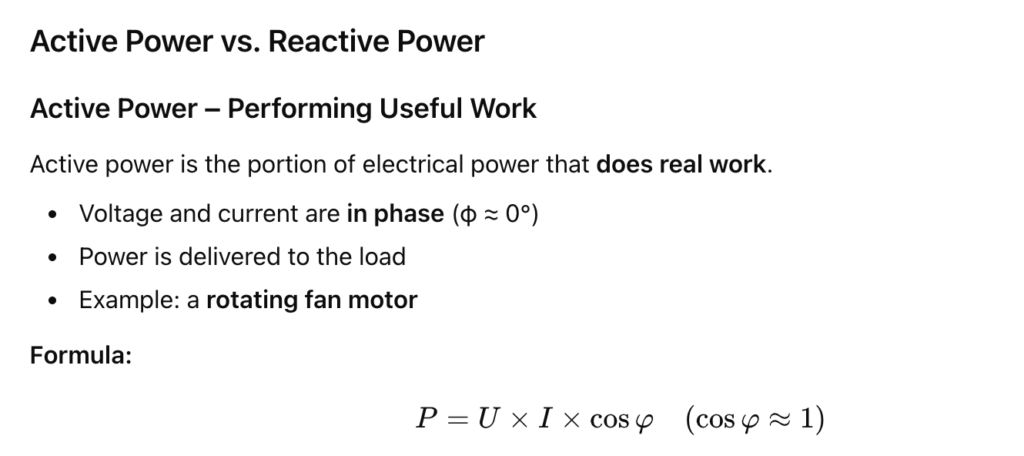
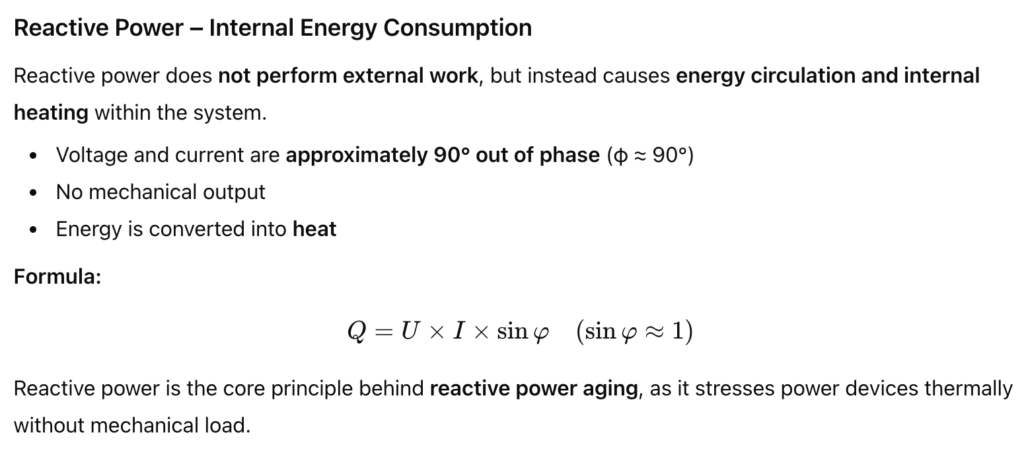
Figure 2. “Reactive” ≠ “Useless”
2. Core Logic: Why Reactive Power Aging Is Necessary
Most power module failures are not sudden defects, but the gradual evolution of hidden weaknesses.
During manufacturing, microscopic imperfections may occur in:
Die-to-substrate solder joints
Encapsulation materials
Internal interconnections
Examples include:
Micron-scale voids in solder layers
Micro-cracks in resin encapsulation
Partial delamination between chip and baseplate
Under low stress or room temperature, these defects remain invisible. However, during real operation, current-induced heating and thermal cycling cause expansion and contraction, gradually enlarging these flaws—eventually leading to short circuits, open circuits, or performance degradation.
Reactive power aging intentionally accelerates this failure evolution, allowing defects to appear before shipment.
This mechanism is supported by two key formulas and validated by real-world data.
2.1 Formula 1: How Does Reactive Power Generate Screening Heat?
The reactive power equation is:
Q=U×I×sinφ
Where:
Q: Reactive power (Var)
U: Applied voltage (V)
I: Current (A)
φ: Phase angle between voltage and current
(During reactive aging: φ ≈ 90°, sinφ ≈ 1)
Although reactive power does not perform external work, power semiconductor devices (IGBTs, MOSFETs) still generate internal losses, fully converted into heat:
Conduction Loss
Pcon=Vsat×I×D
Switching Loss
Pswitch=f×Eswitch
Total Loss
Ptotal=Pcon+Pswitch
Thermal energy (Q_heat) is approximately proportional to total power loss.
This means that during reactive power aging, modules generate stable and continuous heat, closely matching real operating thermal conditions—without excessive active power consumption.
2.2 Formula 2: Why Temperature Accelerates Defect Exposure
This effect is explained by the Arrhenius accelerated aging model:
k=A×e−(Ea/R×T)
Where:
k: Defect growth rate (1/s)
A: Material-related constant
Eₐ: Activation energy (J/mol)
R: Gas constant (8.314 J/(mol·K))
T: Absolute temperature (K)
Key conclusion:
Higher temperature → faster defect evolution.
During reactive power aging, module junction temperatures are typically controlled between 100°C and 145°C, close to the upper limits of silicon device operation. This dramatically accelerates defect exposure—turning failures that would normally occur after thousands of operating hours into detectable issues within tens of aging hours.
2.3 Why Not Use Active Power Aging Instead?
A common question is: Why not directly apply active power aging?
Yes, active power aging generates heat—but it comes with drawbacks:
cosφ ≈ 1 → high active power consumption
Excessive electrical stress
Risk of damaging otherwise qualified modules
In contrast, during reactive power aging:
cosφ ≈ 0 → minimal active power loss
Sufficient thermal stress via reactive current
Precise, controllable, and gentle screening
For example, a reactive aging system using three-phase reactors as loads can control output current with <2% error and extremely low stray inductance, ensuring accurate and repeatable screening results.
3. What Does Reactive Power Aging Mean for End Users?
Reactive power aging is not a manufacturer’s internal exercise—the real beneficiaries are end users.
Reduced Early Failure Risk
Modules that pass reactive aging show over 80% reduction in early failure rates, preventing unexpected shutdowns in EVs or power grid systems.
Enhanced Long-Term Reliability
By eliminating latent defects, qualified modules can operate reliably for many years under high temperature and high switching frequency conditions.
A wind power project in Xinjiang reported a 31% system failure reduction and 5.2% annual energy output increase after adopting fully screened power modules.
Lower Maintenance Costs
Power modules are high-value, core components. Proactive screening significantly reduces replacement costs, downtime, and operational losses.
4. Conclusion
Reactive power aging is like high-intensity warm-up training before competition.
It is not wasted effort, but a scientifically designed stress test—supported by power loss models, accelerated aging theory, and real industrial data. This “test of endurance” ensures that every power module leaving the factory is ready to withstand real-world operating conditions over time.
At KOE ELECTRONIC, reactive power aging is a critical step in delivering stable, reliable, and long-life power modules to our customers worldwide.